DaySignal for Jira
Stop drowning in 60 Jira emails a day. DaySignal surfaces only what needs your attention — blockers, overdue, at-risk, stalled — in one calm daily digest, plus realtime alerts for the few things that can’t wait. Delivered where you work: Jira, email, Slack, or Microsoft Teams.
Built on Atlassian Forge · Free for up to 10 users · Cloud Fortified ready
The problem Atlassian customers asked to fix 9 years ago
Developers get ~60 Jira emails a day, only ~6% are relevant. JRACLOUD-1369 (“Reduce Jira email chattiness”) has 1,574 votes and 262 linked cases — open since 2015.
Information overload
Hundreds of tickets, dozens of sprints. PMs open Jira and don’t know where to start their day.
Standups eat time
Daily meetings exist because nothing else surfaces blockers. 5×30 min/week per PM, multiplied across the team.
Dashboards = data, not decisions
Burndown charts answer “how much” — not “what should I do today?” PMs want decisions, not graphs.
See DaySignal in action
Smart daily digest and flexible real-time notifications — a quick walkthrough of how DaySignal turns Jira noise into one clear signal.
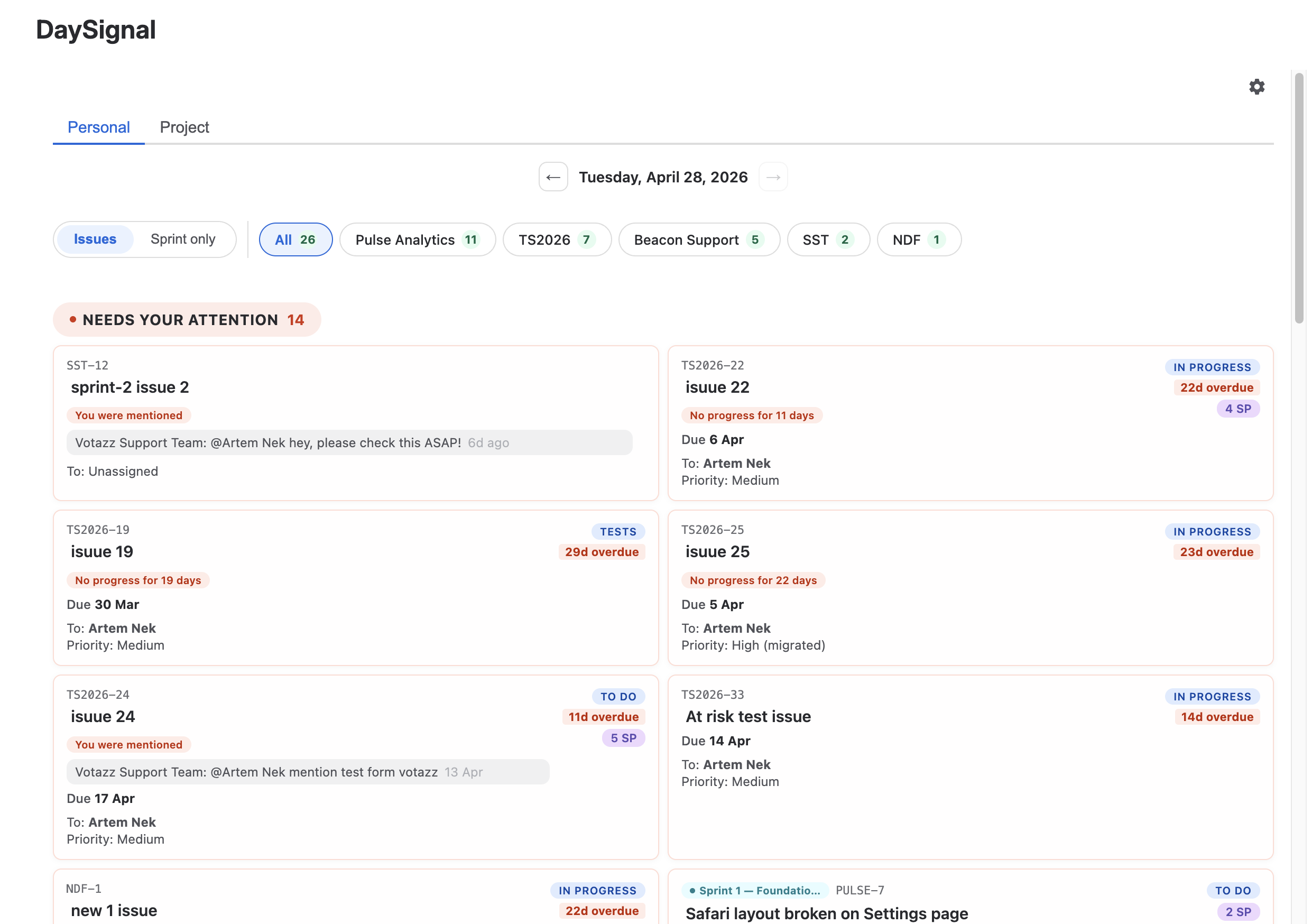
Personal mode
Your daily focus across all projects
DaySignal scans every project you’re involved in and pulls out only what’s pulling on you today: mentions you haven’t replied to, overdue issues, things that haven’t moved in days. One screen, no scrolling, no chaos.
- Mentions you haven’t replied to — highlighted
- Overdue across projects with day count
- Stalled issues (no progress 6+ days)
- Filter by project / sprint
Project mode
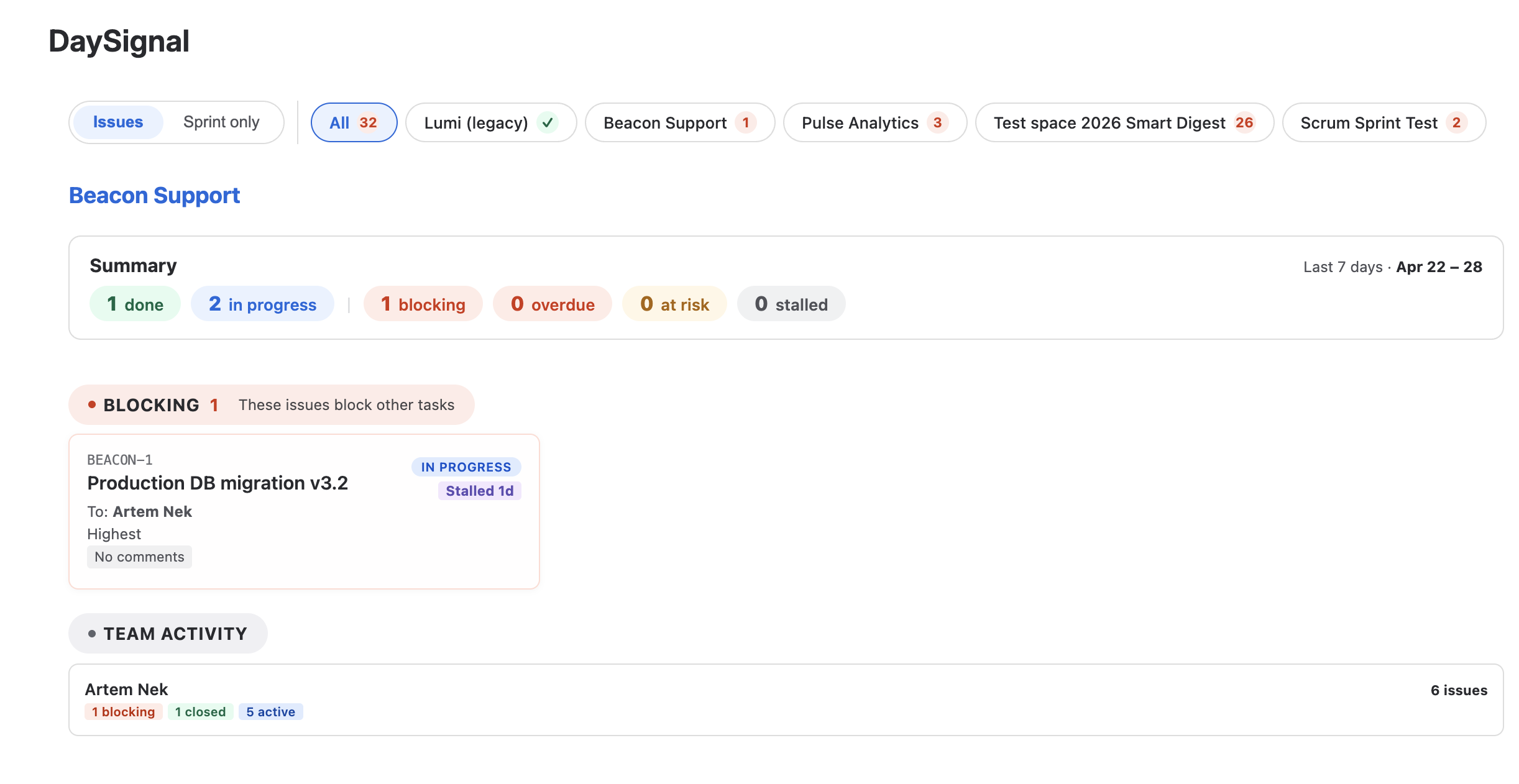
PM-grade project health at a glance
Pick a project and see exactly what’s blocking the team, where things have stalled, and who’s working on what. No clicking through Jira filters — the answers are surfaced before you ask.
- Summary: done · in-progress · blocking · overdue · at risk · stalled
- Blocking issues prioritized first
- Team activity per member
- Rolling 7-day window
Sprint deep-dive
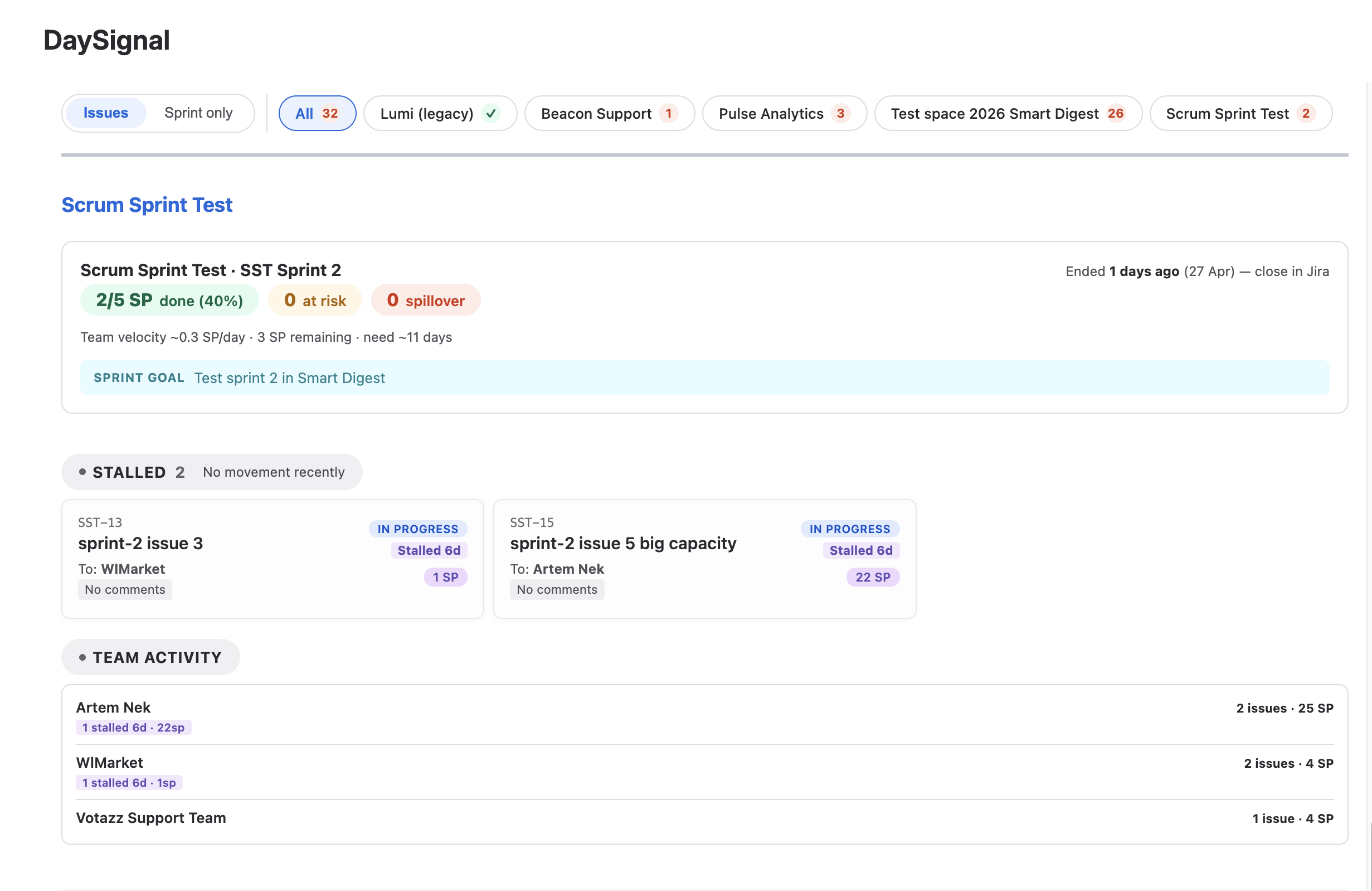
Velocity, spillover, sprint goal — in one place
Active sprint goal, real-time velocity, done vs at-risk vs spillover, plus team activity by member. Built-in for sprint review prep — no spreadsheet juggling.
- Sprint goal & current velocity
- Done · At risk · Spillover summary
- Stalled issues highlighted
- Team activity per member
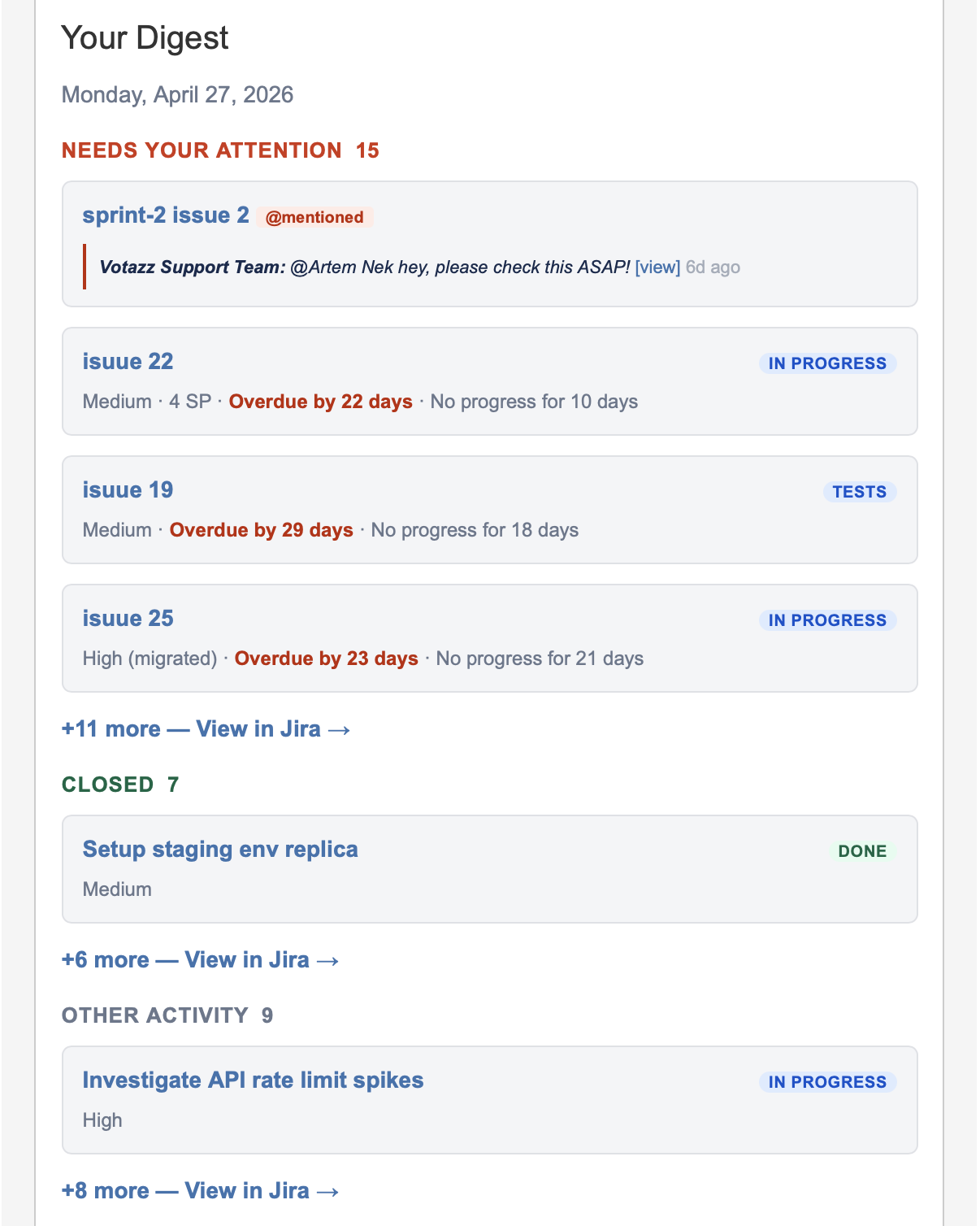
Morning digest — in your inbox, Slack, or Teams
The same smart digest delivered at 9am — to your inbox, a Slack channel, or Microsoft Teams. Click straight into Jira. Standup becomes optional.
Personal email
Mentions, overdue, closed yesterday. Everything you need for morning planning.
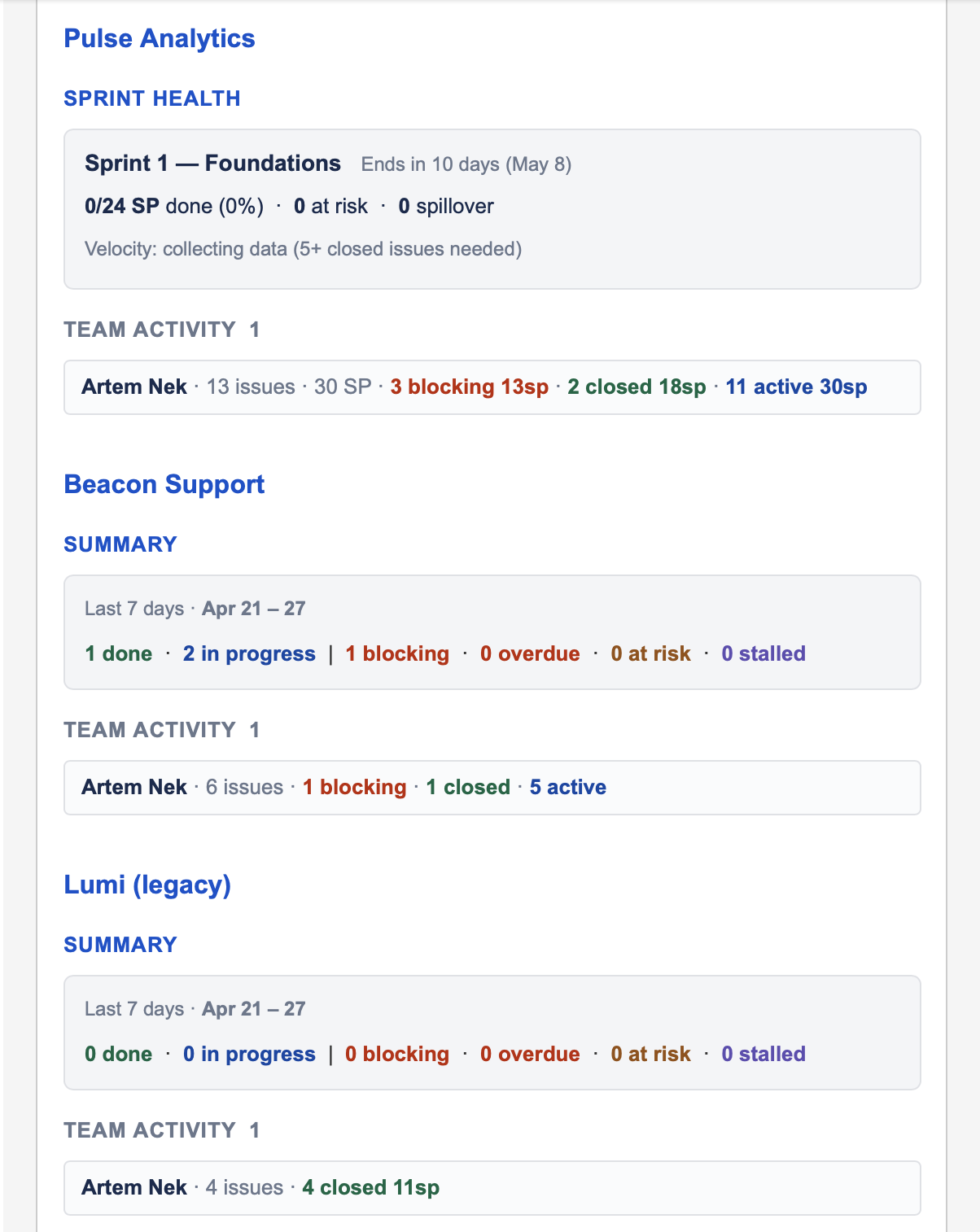
Project email
Sprint Health, multi-project blocker summary, team activity. One email, three dashboards’ worth.
New — Realtime alerts
What’s worth interrupting you? Only you choose.
The whole point of DaySignal is to unsubscribe you from realtime noise — the digest batches it all into one calm daily read. Realtime alerts are the deliberate exception: hand-pick the few events that are allowed to interrupt you, and let everything else wait for the morning digest.
Six events. All opt-in.
Mentions in descriptions and comments, assignments, status, priority, due date and label changes. Everything is off by default — you turn on only what deserves an interrupt.
Delivered where you work
Straight to your Slack DMs from the DaySignal bot — private, one OAuth click to connect. Or a Slack channel, Microsoft Teams, or email if that’s where your team lives.
Signal, not noise
Role filter limits alerts to issues where you’re the assignee or reporter. Snooze pauses everything for a few hours and resumes automatically. Smart deduplication means the same event never reaches you twice.
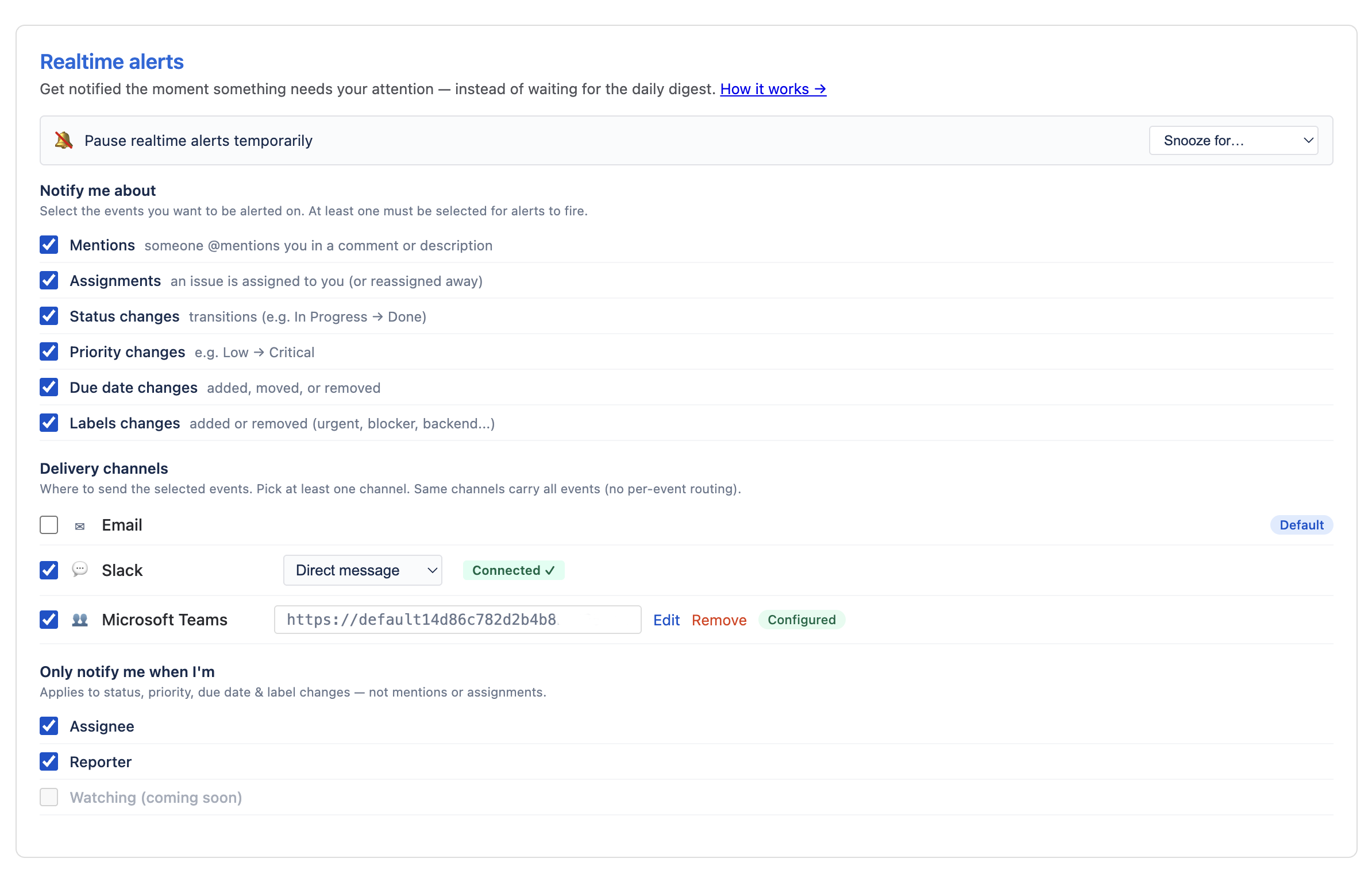
Each teammate configures their own alerts — no team-wide spam, no admin bottleneck.
Built for these teams
Project Managers
Replace standup-prep with a 2-minute scan of one digest per project.
Engineering leads
See velocity, blockers, stalled work without opening Jira filters.
Senior PMs / Directors
Multi-project view: blockers and overdue across all your portfolio at once.
Async / remote teams
Replace daily standups with the morning email — same signal, no meeting.
The math behind DaySignal
Conservative numbers, sourced from Atlassian’s own customer demand data, McKinsey research, and BLS wage stats. No marketing-fluff multipliers.
Methodology & assumptions. Estimates use industry-average inputs: ~7 minutes of inbox-management and standup-prep time reclaimed per user per workday (vs. UC Irvine and McKinsey research showing knowledge workers spend ~2.5 hrs/day on email and lose ~23 min per interruption); blended global fully-loaded engineering rate of $65/hour (vs. published 2026 benchmarks of $20–$150/hour by region); 225 working days/year; and a 40% effective-utilization factor reflecting that not all reclaimed time converts to productive output (Brynjolfsson 1993; APQC 2024). Actual results depend on team size, current Jira notification configuration (Atlassian’s default is 3-min batching, customizable), adoption depth, and workflow patterns. Customers with already-tuned notifications will see proportionally smaller gains. We recommend a 30-day pilot to validate against your own baseline.
Sources: JRACLOUD-1369 (1,574 customer votes, 9 years open) · McKinsey “The Social Economy” · BLS OOH Software Developers · Solow Productivity Paradox · APQC 2024 Knowledge Worker Productivity
The cost of late visibility
PMs lose hours every week chasing status. Missed blockers turn into spillover. Late-detected at-risk work becomes failed sprints. The numbers below come from PMI, Standish CHAOS, and Atlassian’s own research.
“Leaders and teams waste 25% of their time just searching for answers… 72% often find that the only way to get the information they need is to ask someone or schedule a meeting.”
— Atlassian, State of Teams 2025 · 12,000 knowledge workers + 200 executives surveyed
Methodology & assumptions. Conservative scenario using low end of cited benchmarks. 1:8 PM-to-engineer ratio (Ken Norton range 5–9 / SYNQ 2024 median 1:8.3 of 50 scaleups). 15% of PM time on Jira-specific status work (derived from Atlassian State of Teams 2025 finding that 25% of work time is wasted searching for answers — assumed ~60% of that is Jira-context for engineering PMs). 50% reduction in sweep time via daily digest (estimate — to be validated in pilot). ~160 blockers/year for a 5-project / 50-eng team (estimate based on agile sprint patterns; Standish CHAOS shows 50% of projects “challenged”). 30% early-detection rate on blockers via priority/comment signals (conservative estimate). 2 dev-days saved per early-caught blocker (directionally per IBM Systems Sciences Institute cost-of-defect curve — note: exact multipliers in that curve have been challenged in recent literature, so we use a conservative 2-day figure). Rates: $65/hr blended global engineer (FullStack 2025), $60/hr blended Tech PM (median across Indeed $117,881 / Built In $117,710 / Glassdoor $139,974 / PayScale $106,208 — base salary only, US 2026). Excludes Confluence/Slack/meeting savings. Does not double-count the engineer-side ROI above.
PM-side sources: PMI Pulse 2018 · Atlassian State of Teams 2025 · Norton (5–9 devs per PM) · SYNQ 50-scaleup (1:8.3) · Standish CHAOS 2020 · Agile Seekers / Standish 40% story-points · Glassdoor Tech PM 2026 · Indeed Tech PM 2026 · Built In Tech PM 2026 · FullStack 2025 Dev Rates
Simple, transparent pricing
Free up to 10 users. Pay only as your team grows.
Pricing follows Atlassian Marketplace standard tiers. Annual billing saves 17% vs monthly. All pricing in USD.
Frequently asked questions
Everything you need to know before installing.
Does it replace daily standups?
For many remote teams, yes. The morning email shows what each person worked on, what’s blocking, what’s stalled — the same content a standup surfaces. Some teams keep a weekly standup for human alignment and use DaySignal for the daily signal.
How is this different from native Jira email notifications?
Jira notifications are per-event — every comment, every status change, often 60+ per day. DaySignal is per-day and per-project: one digest that classifies issues by signal type (blocking, overdue, at risk, stalled) instead of streaming every change.
Where does my data go?
Nowhere. DaySignal is a Forge app — your Jira data stays inside Atlassian Cloud. We don’t run external servers. Cloud Fortified compliant.
Does it work with Jira Service Management?
Currently focused on Jira Software (Scrum & Kanban). JSM support is on the roadmap — sign up for early access and we’ll notify you.
Can each user customize their own digest?
Yes. Each team member can pick their delivery time, projects to include, and email vs in-app preference. Admins can set defaults; users can override.
Is there a free tier?
Yes — DaySignal is free for teams up to 10 users (Atlassian standard). All features are included; we never gate functionality on the free tier.
Where can I find documentation?
Full setup, settings reference, troubleshooting, and screenshots are at docs.votazz.co/daysignal-for-jira. No login required.
Quiet your Jira inbox. Decide what matters today.
Free for the first 10 users. Set up in under 60 seconds.
Want details first? Read the docs →